Why does a straw in water look bent?

 First, let me give you the answer in 30 seconds.
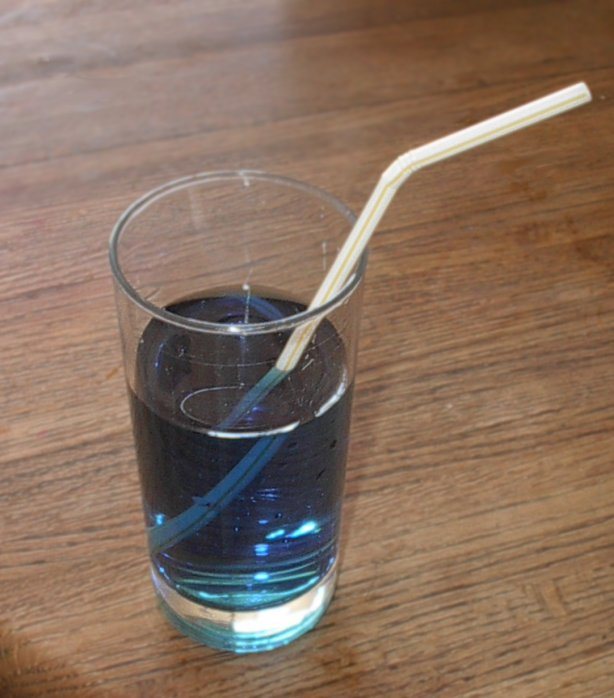
The straw itself is not bent. Light coming from the part of the straw under water changes direction as it passes from the water into the air at the surface (this is called refraction). But your eyes and brain decide where things are by assuming light has traveled in a straight line. So only the underwater part seems to be in a different place, and the straw looks broken at the surface.
We see things where the light comes from
We see things because light coming from them reaches our eyes. We sense that an object is in the direction the light came from. Light from the part of the straw above the water travels only through air to reach our eyes, so we see that part where it really is.
Light changes direction at the surface
On the other hand, light from the part under the water changes direction where it leaves the water and enters the air. This is called refraction. Light travels in a straight line inside the same material, and it changes direction only at the boundary between the water and the air.
Direction changes because speed changes
Light changes direction because its speed changes. In air, light travels at about 300,000 kilometers per second, but in water it slows down to about 226,000 kilometers per second. When light crosses the boundary at a slant, its direction changes along with its speed. When it crosses straight on, it slows down but does not change direction.

Eyes and brain assume a straight line
Our eyes and brain cannot tell that the light bent along the way. They treat the light as if it came in a straight line, and decide that the object is where that line points back to. That is why the underwater part looks shifted from its real position, and the straw looks broken at the water's surface. The underwater part can also look thicker than the part outside.
Want to know more?
- If you take the straw out of the water, it is still straight. This shows that it only looked bent because of the path the light took.
- Light is slower in water than in air, and even slower in glass, at about 200,000 kilometers per second. The more a material slows light down, the more the light bends.
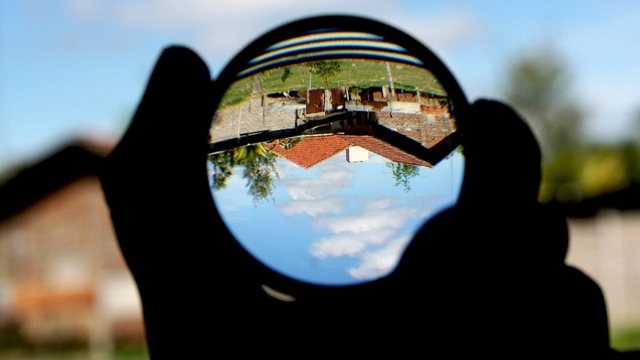
- Magnifying glasses, prisms, and rainbows all happen because of refraction, when light changes direction. Our own eyes also use refraction to gather light.

Quick quiz: test yourself
Why does a straw in water look bent?
Show the answer
- Light changes direction
- The water bends the straw
- The water absorbs the light
Light changes direction Light from the underwater part changes direction at the surface, but our eyes and brain assume it traveled straight, so that part looks shifted.
Light from the underwater part changes direction at the surface, but our eyes and brain assume it traveled straight, so that part looks shifted.
Next quiz ›Sources
- Refraction and SightThe Physics Classroom
- Refraction of lightScience Learning Hub (University of Waikato)
- Bent PencilSchool of Physics, The University of Sydney
This article was written after checking the sources above as of 2026-10-03. Explanations may change as research progresses. Photo credits are shown below each photo.