Why do auroras glow green and red?

 The colors are light given off by tiny particles of air.
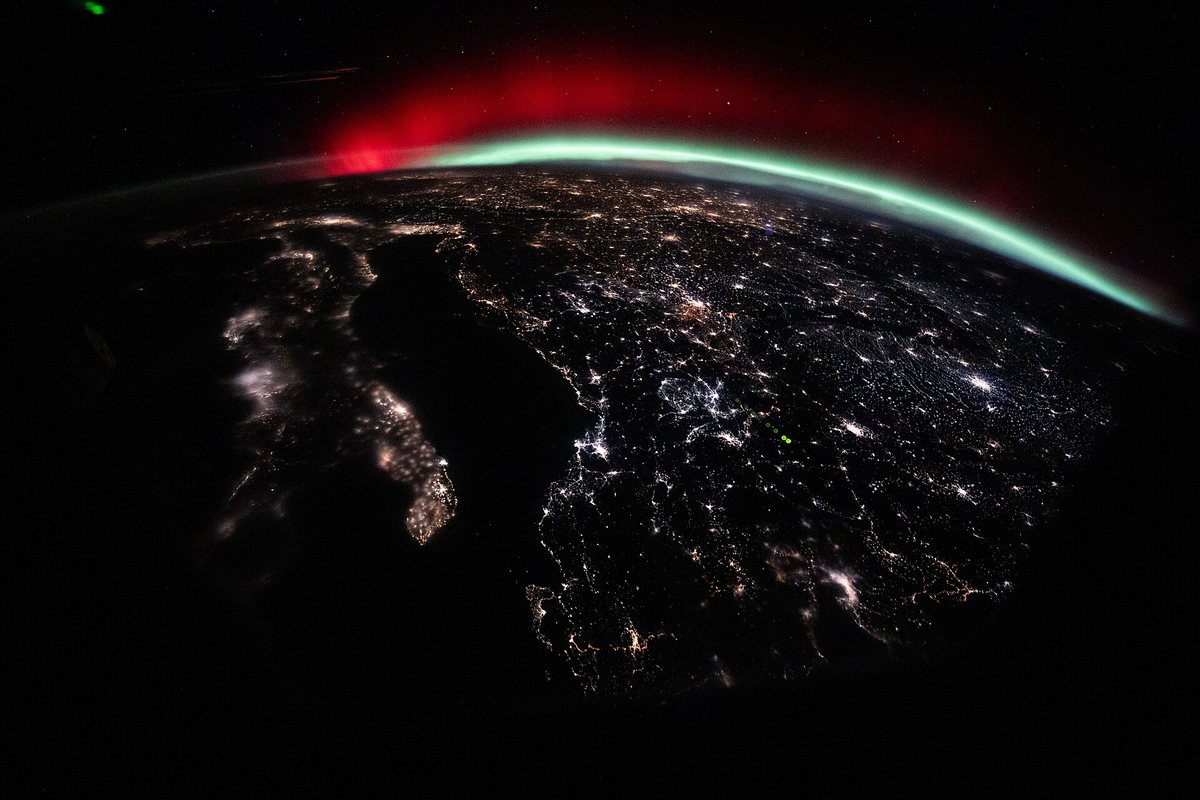
Aurora colors are made when electrons pouring in from space hit oxygen and nitrogen high up in the sky and make them glow. The green we see most often, and the red higher up, both come from oxygen, while blue, purple, and pink come mostly from nitrogen. The color changes depending on how high the light is given off.
An aurora is a neon sign in the sky
According to the Space Weather Prediction Center of the U.S. National Oceanic and Atmospheric Administration (NOAA), an aurora happens when electrons, sped up in the space around Earth by energy from the wind blowing from the Sun (the solar wind), pour down into the sky along magnetic field lines and hit air particles at heights of 100 kilometers or more, making them glow. It works much like a neon sign, where electrons hit the gas inside the tube and make it glow.
Green and red are the colors of oxygen
When oxygen or nitrogen is hit, it takes in energy and is energized for a short time. When it settles back down, it gives off light. The pale green that we see most often and the deep red that we see less often are both light given off by oxygen. Depending on how the oxygen is energized, it glows either green or red.
Each color glows at a different height
Oxygen in the state that gives off red light takes more than 150 seconds before it glows. Down low, where the air is thick, it bumps into other particles before then and can no longer glow, so red light only appears high up, where the air is thin. Green can be given off in about 1 second, so it glows lower down, too. The typical heights differ by source: NOAA gives 120–400 kilometers for green and above 300 kilometers for red, while NASA gives 100–200 kilometers for green and above 200 kilometers for red.
NOAA and NASA give different height figures, so the article lists both.

Purple and pink are the colors of nitrogen
The lower edge of an aurora sometimes looks purple or pink. This is light given off mostly by nitrogen. Nitrogen gives off light almost immediately after being hit, so it can glow even lower down. At dawn or dusk, sunlight can also hit nitrogen high up and make it glow purple.
Want to know more?
- Some people say auroras looked whitish to them. NOAA explains that this is because human eyes have trouble telling colors apart in the dark, and that bright auroras show their true colors.
- The green light we see most often is light of one exact color, with a wavelength of 557.7 nanometers.
- The name "aurora" comes from the Latin word for the goddess of dawn, and Galileo is said to have been the first to use it.

Quick quiz: test yourself
What gives off the green light of an aurora?
Show the answer
- Nitrogen
- Hydrogen
- Oxygen
Oxygen Electrons pour in from space and hit oxygen high in the sky, which gives off green light. Purple and pink come mostly from nitrogen.
Electrons pour in from space and hit oxygen high in the sky, which gives off green light. Purple and pink come mostly from nitrogen.
Next quiz ›Sources
- Aurora TutorialNOAA / NWS Space Weather Prediction Center
- AurorasNASA Science
This article was written after checking the sources above as of 2026-10-03. Explanations may change as research progresses. Photo credits are shown below each photo.