Why is a moving bicycle hard to tip over?

 The answer is a little different from the explanation you often hear.
When a moving bicycle leans, the handlebars naturally turn toward the side it is leaning, and the wheels come back under the bike, so it is hard to tip over. The often-heard idea that "the wheels spin like a top" turned out not to be necessary: a 2011 experiment showed a bike could right itself without it. Some mysteries about exactly how it works still remain.
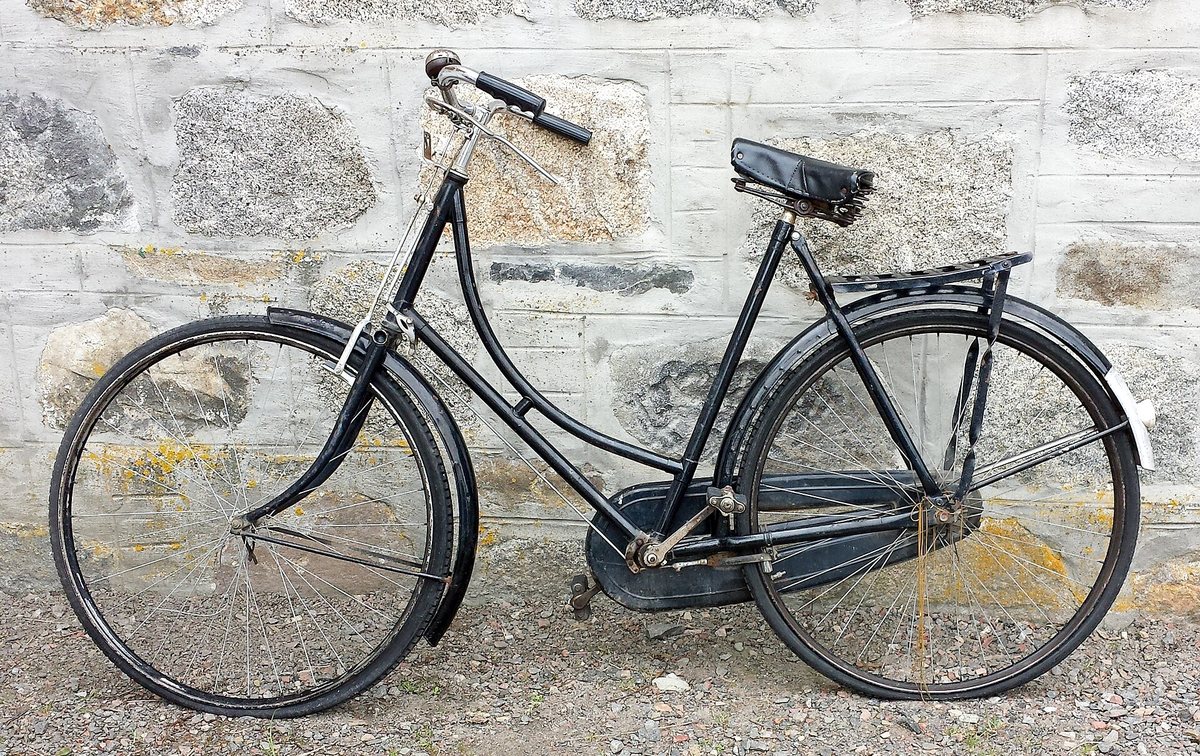
Two common explanations
Two explanations have often been given for why bicycles are hard to tip over. One is the "gyroscopic effect," where spinning wheels try to keep their position, like a spinning top. The other is the "caster effect": the point where the front wheel touches the ground is behind the axis the handlebars turn on, so the wheel lines up with the direction of travel, like the front wheels of a supermarket cart.
A bicycle without the spinning-top effect
In 2011, a research team from Delft University of Technology, Cornell University, and other schools built a special bicycle without these two effects. They attached discs spinning the opposite way to its small wheels to cancel out the spinning-top effect, and they put the point where the front wheel touches the ground in front of the axis. Even so, when it rode faster than about 5 miles per hour (about 8 km/h), it went back to an upright position on its own, even after being lightly pushed from the side.

Steering toward the fall
What the researchers thought was important is that the bicycle "steers toward the side it is falling." When the bike leans, the front wheel turns toward that side and the wheels come back under the bike, so it can right itself. The gyroscopic and caster effects are not essential, but they are also explained as usually helping on ordinary bicycles.
Many effects working together
The research reported that changing just 1 of these things (the caster effect, the spinning-top effect of the front wheel, or where the weight sits around the handlebars) could turn a stable bicycle into an unstable one, or the other way around. Bicycle stability has been studied for nearly 150 years, but a few mysteries are said to remain even now.
Want to know more?
- A computer model of an ordinary bicycle, published by Delft University of Technology researchers in 2007, uses as many as 25 numbers, such as sizes and weights.
- The researchers say that today's bicycle shape may still leave room for good designs that have not been tried yet, which could help make safer bicycles.

Quick quiz: test yourself
What is a key reason a moving bike stays up?
Show the answer
- It steers toward the fall
- The wheels spin like tops
- The tires grip the ground
It steers toward the fall When the bike leans, the front wheel turns to that side and the wheels move back under the bike. Tests showed it can recover even without the spinning-top effect.
When the bike leans, the front wheel turns to that side and the wheels move back under the bike. Tests showed it can recover even without the spinning-top effect.
Next quiz ›Sources
- A bicycle built for none: Riderless bike helps researchers learn how balance rolls alongScienceDaily(Cornell University の発表資料)
- Balancing bicyclesDelta(TU Delft)
This article was written after checking the sources above as of 2026-10-03. Explanations may change as research progresses. Photo credits are shown below each photo.