Why do flames stretch upward?

 The key to the answer is gravity.
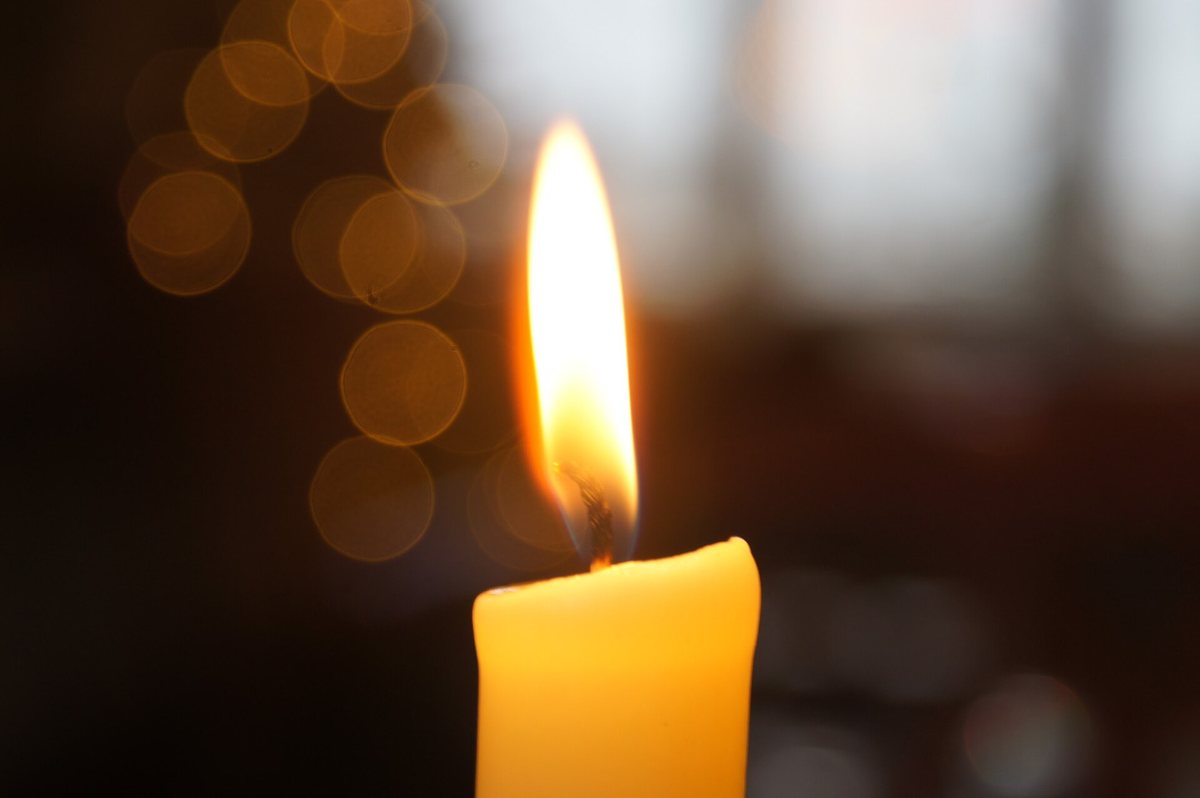
Flames stretch upward because the burning, heated gas becomes lighter than the air around it, and on Earth, where there is gravity, it rises. Fresh air then flows in from below to take its place, giving the flame an upward teardrop shape. Inside a spacecraft, where gravity is barely felt, this flow does not happen, and the flame becomes round.
Hot gas becomes lighter
When something burns, the flame and the gas around it get very hot. According to NASA, a flame is about 2300 kelvin (about 2000℃) and the air around it is about 300 kelvin (about 27℃), so the density of the hot gas (its weight for the same volume) is about 1/8 that of the surrounding air. The lighter gas rises, as if pushed up by the cool, heavy air that gravity pulls down. This upward force is called buoyancy.
Fresh air flows in from below
As the hot gas rises, cool air from around it flows in underneath. NASA explains that the shape of a candle flame comes from light, warm air rising while cool air moves in from below to replace it. Pulled along by this upward flow, the flame stretches up into a teardrop shape. Flames flicker because this flow becomes uneven.

Why the tip of the flame is yellow
The tip of a candle flame is bright yellow because soot (tiny unburned bits of carbon) glows from the heat. According to NASA, on Earth the upward flow carries the soot to the tip of the flame, so the tip looks yellow.
In space, flames become round
Where gravity is barely felt (microgravity), such as on a space station, hot gas does not rise. Experiments on the Space Shuttle and elsewhere confirmed that a candle flame becomes a round shape close to a ball or half-ball, and turns into a blue flame with little soot. Oxygen then reaches the flame by slowly spreading out, a movement called "diffusion."
Want to know more?
- Results from a Space Shuttle experiment shared by NASA concluded that, given enough space, a candle can keep burning even in microgravity.
- For flames that burn gas blown out of a nozzle, results also show that in microgravity they grow taller and wider than on Earth, and make 5–8 times more soot.
- NASA is also working on an experiment (FM2) to study how things burn on the Moon, where gravity is about 1/6 of Earth's.

Quick quiz: test yourself
Why do flames stretch upward?
Show the answer
- Hot gas is lighter and rises
- Fire naturally moves upward
- Smoke pulls the flame up
Hot gas is lighter and rises Hot gas from burning is lighter than the surrounding air, so on Earth, with gravity, it rises. In a spacecraft, flames become round.
Hot gas from burning is lighter than the surrounding air, so on Earth, with gravity, it rises. In a spacecraft, flames become round.
Next quiz ›Sources
- Candle Flame – 1g vs MicrogravityNASA
- Why NASA is studying flames in spaceNASA Science
- Combustion ScienceNASA Glenn Research Center
- Candle Flames in Microgravity: USML-1 Results - 1 Year LaterNASA Technical Reports Server
This article was written after checking the sources above as of 2026-10-03. Explanations may change as research progresses. Photo credits are shown below each photo.