Why is a rainbow shaped like an arc?

 In fact, a rainbow is really round.
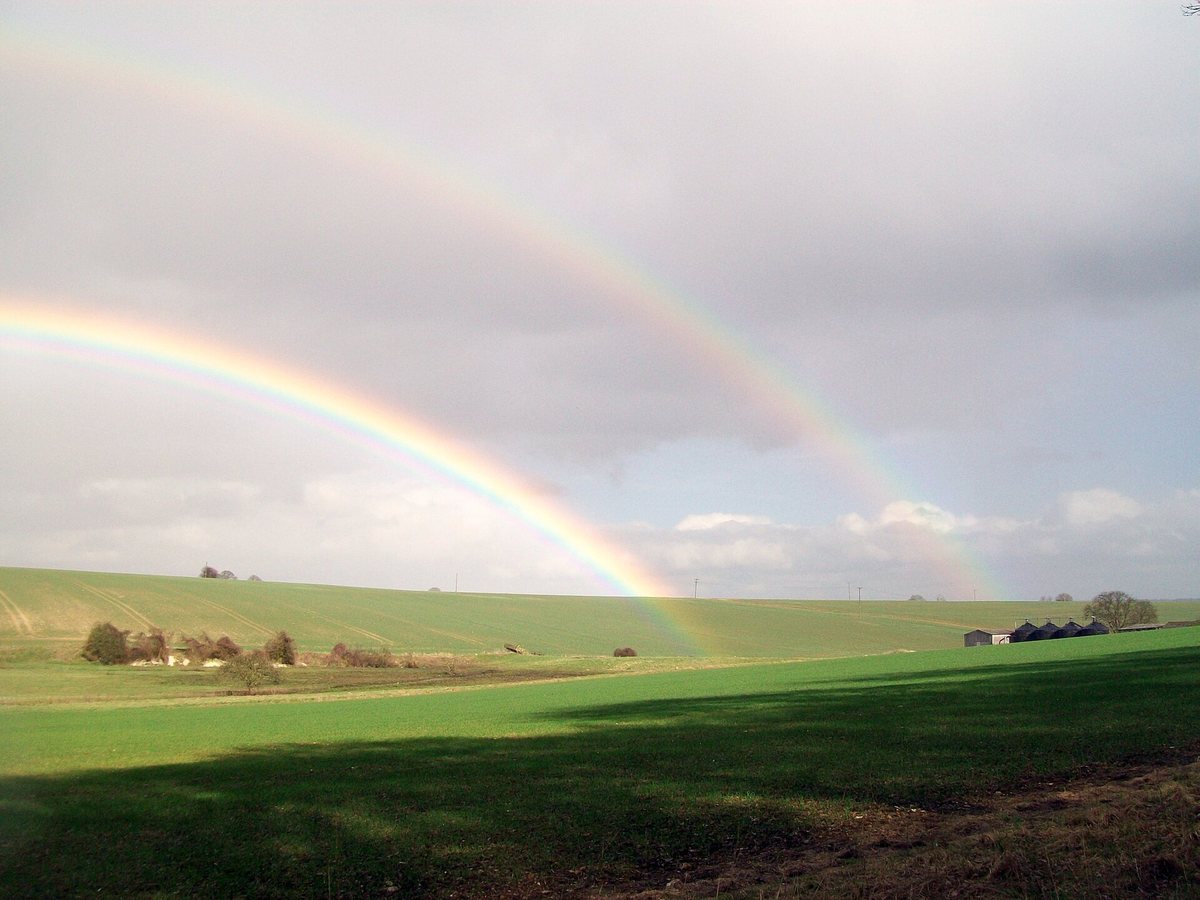
A rainbow looks like an arc because only the raindrops about 42 degrees away from the point directly opposite the sun send colored light to your eyes. Joining those directions makes a circle, but on the ground the lower half is blocked by the earth, so you see an arc. From an airplane, you can sometimes see a round rainbow.
Light bends inside raindrops
A rainbow begins when sunlight enters raindrops in the air. The light bends as it enters a drop, bounces off the back of the drop, and bends again as it comes out. Each color bends by a slightly different amount, so white sunlight splits into colors from red to violet.
Only the 42-degree direction shines
The light coming out of a raindrop gathers most strongly in a direction about 42 degrees away from the direction of the original sunlight. So when you stand with the sun behind you, only the raindrops about 42 degrees away from the "point opposite the sun", which lies just beyond the head of your own shadow, send rainbow light to your eyes. Those raindrops line up in the shape of a cone with your eye at its tip, so the rainbow you see is a circle.

The ground hides the lower half
When you are on the ground, the lower half of the circle is blocked by the ground and you cannot see it. In the morning or evening, when the sun is low, you see a big rainbow close to a half circle. The higher the sun, the smaller the arc, and if the sun is too high, you cannot see a rainbow from the ground at all. From a high mountain or an airplane, you may see a rainbow bigger than a half circle, or even a round one.
Red outside, violet inside
The order of a rainbow's colors follows a rule, too. Red light gathers at a slightly larger angle and violet light at a slightly smaller one, so the outside of the rainbow is red and the inside is violet. Because its shape depends only on the direction and angle of the light, a rainbow changes with the viewer's position, and no matter how close you get, you can never reach its end.
Want to know more?
- The faint secondary rainbow outside the main one forms when light bounces twice inside the raindrops, and its colors are in the opposite order.
- The slightly darker band of sky between the main and secondary rainbows is called "Alexander's dark band", named after a person who described it about 1800 years ago.
- On a sunny day, stand with the sun behind you and spray a fine mist with a hose or spray bottle. You can make a small rainbow of your own.

Quick quiz: test yourself
Why does a rainbow look like an arc?
Show the answer
- Rain clouds are round
- Because Earth is round
- The ground hides the circle's lower half
The ground hides the circle's lower half Raindrops about 42 degrees from the point opposite the sun send light to your eyes, so a rainbow is really a circle. On the ground, the lower half is blocked.
Raindrops about 42 degrees from the point opposite the sun send light to your eyes, so a rainbow is really a circle. On the ground, the lower half is blocked.
Next quiz ›Sources
- Why are Rainbows Curved as Semicircles?University of Illinois Physics Van
- Rainbows(Physics 302l 講義ノート)The University of Texas at Austin
- RainbowsUniversity of St Andrews
This article was written after checking the sources above as of 2026-10-03. Explanations may change as research progresses. Photo credits are shown below each photo.