How do honeybees tell each other where flowers are?

 First, let me give you the answer in 30 seconds.
When a honeybee finds good flowers and returns to the hive, it tells the others by "dancing" inside the hive. For faraway flowers, it traces a figure 8: the time it spends waggling its rear end while moving straight shows the distance, and the angle shows the direction of the flowers as seen from the sun. The other bees are thought to fly to the general area and then also rely on the flowers' scent at the end.
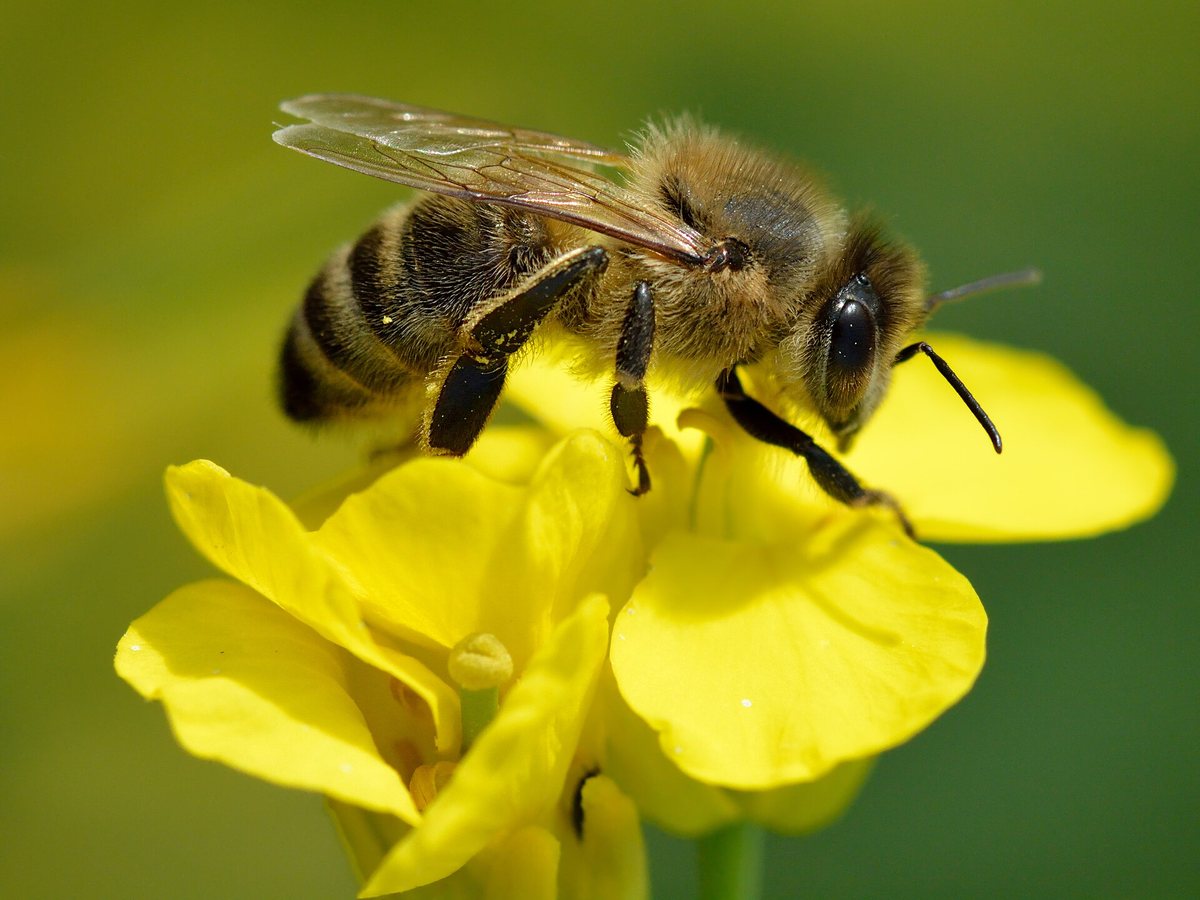
"Dancing" inside the hive
When a worker bee comes back to the hive with nectar or pollen and has found good food, it "dances" on the wall of the comb. The bees around it follow behind the dancer to pick up the information, then fly out of the hive. The dance mainly tells 2 things: the "distance" to the flowers and their "direction."
The dance changes with distance
The shape of the dance changes with the distance to the flowers. When they are closer than 50 m from the hive, the bee does a "round dance," circling around in a small loop. This says "it's nearby" but does not give a direction. For 50–150 m, it does a crescent-shaped dance, and for more than 150 m, it does a "waggle dance" that traces a figure 8 and tells both distance and direction.
Waggle time shows distance
In the waggle dance, the bee moves straight ahead while strongly waggling its rear end from side to side, then circles back in a half loop to where it started. The longer this straight part lasts, the farther away the flowers are. In one example, a waggle lasting 2.5 seconds meant the flowers were about 2,625 m away.
"Straight up" means the sun
The way direction is shown is even more amazing. Inside the dark hive, the bees can't see the sun, so they treat "straight up" as the direction of the sun. If the flowers are in the same direction as the sun, the bee moves straight up; if they are in the opposite direction, it moves straight down. If the flowers are 60 degrees to the left of the sun, it moves 60 degrees to the left of straight up. Because the sun moves during the day, the angle of the dance for the same flowers changes over time.

Flower scent helps at the end
However, the dance alone is not thought to show exactly where the flowers are. The idea now widely accepted is that the other bees fly to the area the dance points to, and then find the flowers by using clues such as the flower scent on the dancer's body.
Want to know more?
- Karl von Frisch, who figured out what the dance means, received the Nobel Prize in Physiology or Medicine in 1973 for this and other research.
- Research has shown that young bees that have never seen a dance tend to dance with messy directions and distances, and get better by watching older bees dance.
- The dance is used not only for food, but also to tell the others where a new home is when the colony moves.

Quick quiz: test yourself
How do honeybees tell others where flowers are?
Show the answer
- By buzzing their wings
- By leaving a scent trail
- By dancing inside the hive
By dancing inside the hive They dance inside the hive. How long they waggle shows the distance to the flowers, and the direction shows where the flowers are compared with the sun.
They dance inside the hive. How long they waggle shows the distance to the flowers, and the direction shows where the flowers are compared with the sun.
Next quiz ›Sources
- Honey Bee Dance LanguageNC State Extension (North Carolina State University)
- Young Honey Bees Learn Waggle Dancing by Observing Older BeesXishuangbanna Tropical Botanical Garden, Chinese Academy of Sciences
This article was written after checking the sources above as of 2026-10-03. Explanations may change as research progresses. Photo credits are shown below each photo.