Why does steam rise from hot springs?

 In fact, it is not water vapor itself.
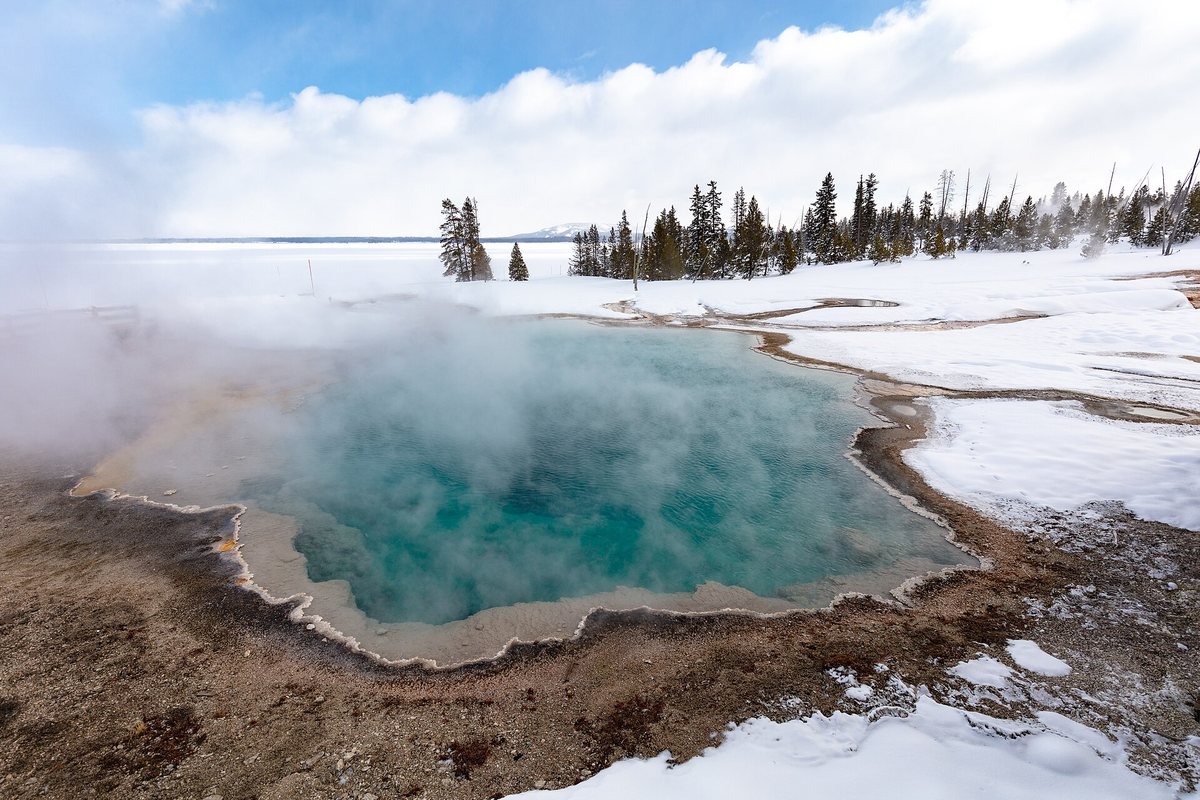
The steam over a hot spring is a cloud of tiny water droplets, formed when water vapor rising from the hot water is cooled by the cold air around it. Water vapor itself is an invisible gas; what looks white is the droplets. The bigger the temperature difference between the water and the air, as on cold days, the more clearly you can see the steam.
Water vapor is invisible
Water is always evaporating from the surface of hot water and becoming water vapor (water in the form of a gas). Water vapor is a clear gas with no smell or color, so you can't see it. An article in Tenki, the journal of the Meteorological Society of Japan, describes asking university students, "Can you see water vapor?" About 80% answered "yes," showing that many people mix it up with steam.
It cools into tiny droplets
Water vapor fresh from a hot spring is warm, but it cools when it touches the air around it. Some of the cooled vapor can no longer stay a gas and turns into tiny drops of water. According to the Natural History Museum and Institute, Chiba, these tiny droplets looking white are what steam really is.

Why there's more steam on cold days
The UK Met Office explains that when cold air passes over warm water, the water vapor coming off the surface is cooled and forms fog, giving "steam fog" over a heated swimming pool as an example. Hot spring steam works the same way: the colder the air, the more easily the vapor is cooled. This is thought to be why steam billows up from outdoor hot spring baths in winter.
Steam is a cousin of fog and clouds
Steam, fog, and clouds are all made of many tiny water droplets floating in the air. Steam disappears once it spreads out a little because the droplets evaporate again and turn back into invisible water vapor.
Want to know more?
- When water turns into water vapor, its volume grows about 1,700 times.
- According to the UK Met Office, the same kind of "steam fog" also forms in autumn when cold air flows over a warm sea.
- In elementary school science in Japan, steam is also taught as "hot water vapor that has cooled into tiny drops of water."

Quick quiz: test yourself
What is the white steam rising from a hot spring?
Show the answer
- Invisible water vapor
- Lots of tiny water droplets
- Smoke from minerals in the water
Lots of tiny water droplets Water vapor from the hot water is cooled by the cold air and turns into tiny droplets. Water vapor itself cannot be seen.
Water vapor from the hot water is cooled by the cold air and turns into tiny droplets. Water vapor itself cannot be seen.
Next quiz ›Sources
- Steam and Airborne WaterLondon South Bank University (Martin Chaplin, Water Structure and Science)
- What is fog?Met Office
- 水蒸気の「飽和」概念について —空気は水蒸気を含むか?—(天気 49巻3号)日本気象学会 (in Japanese)
- 企画展「ワクワクたいけん2005 旅する地球の水」ガイドブック 1-2 雲 浮かぶ水千葉県立中央博物館(日本財団図書館に掲載) (in Japanese)
This article was written after checking the sources above as of 2026-10-03. Explanations may change as research progresses. Photo credits are shown below each photo.