Why does pasta get soft when you boil it?

 First, let me give you the answer in 30 seconds.
Dry pasta softens because it absorbs water in hot water, and the starch inside goes through "gelatinization." Water seeps in little by little from the outside toward the center, so while it is cooking, the outside is soft and the center stays firmer. When a tiny bit of firmness is left in the very center, it is called al dente.
What's inside dry pasta
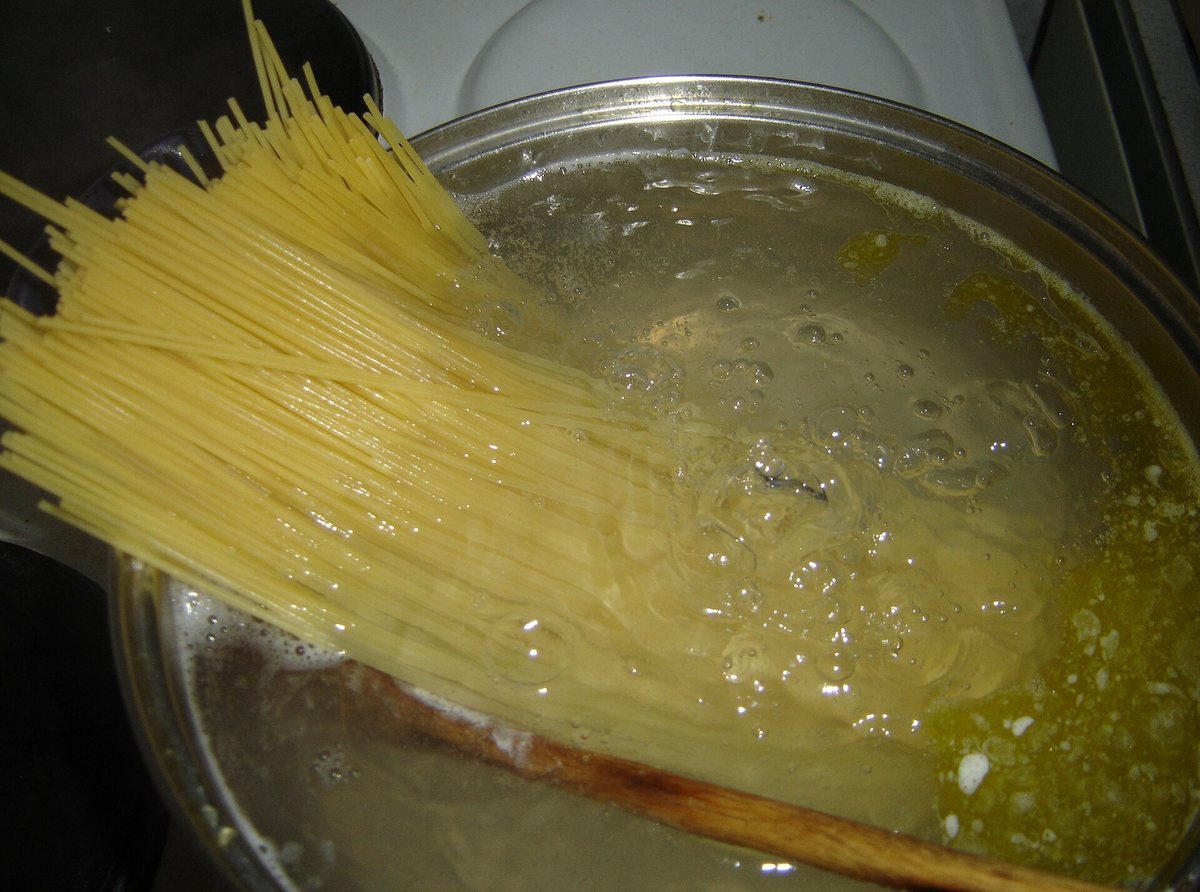
Spaghetti and other pastas are often dried so they can be stored at room temperature, and they are made from just coarse durum wheat flour (semolina) and water. Dry pasta is packed with starch granules about 2–40 μm (micrometers) in size.
Hot water changes the starch
In an experiment where dry spaghetti was soaked in water at different temperatures, it absorbed little water at 40℃ or 50℃, but at 60℃ it absorbed much more, and even more at higher temperatures. The dividing line, around 50℃, is the temperature at which starch changes with water and heat, called gelatinization. It is the same kind of change that makes freshly cooked rice soft and fluffy.
Bar heights are approximate (drawn from the source's experiment graph).

Water moves from outside in
Water soaks into pasta from the surface toward the center. When researchers looked at cross-sections of cooked pasta, the outer part held more water and the center held less. The state where a little firmness remains in the center, giving it a pleasant bite, is called al dente. In this research, the outer part is thought to be in a flexible, rubber-like state, while the inside is in a hard, glass-like state.
The gluten network matters too
Gluten, a protein in wheat, also plays a part. Research on wheat-flour noodles reported that early in cooking, starch gelatinization controls how water is absorbed, and later, how fast the gluten network loosens takes over. Noodles with more gluten switched to the later stage sooner.
Want to know more?
- Dry pasta is grouped by the highest drying temperature: low (about 50℃), high (about 70℃), and very high (about 85℃). Pasta dried at high or very high temperatures has a firmer bite than pasta dried at low temperatures.
- The roughness of pasta's surface depends on the material of the die it is pushed through when it is made. A rougher surface absorbs more water at first, but the total amount of water it can finally absorb stayed the same.

Quick quiz: test yourself
Why does pasta soften when boiled?
Show the answer
- The wheat melts in hot water
- Starch soaks up water and gelatinizes
- Salt loosens the noodles
Starch soaks up water and gelatinizes In hot water, dry pasta absorbs water and the starch inside gelatinizes. Water seeps in from the outside, so the center stays firmer.
In hot water, dry pasta absorbs water and the starch inside gelatinizes. Water seeps in from the outside, so the center stays firmer.
Next quiz ›Sources
- パスタ内での水の移動機構(化学と生物 Vol.52 No.9, 2014)日本農芸化学会(京都大学 小川剛伸・安達修二) (in Japanese)
- Water Sorption Kinetics of Gluten-added Wheat Noodle (Food Science and Technology Research, 2016)日本食品科学工学会(J-STAGE)
This article was written after checking the sources above as of 2026-10-03. Explanations may change as research progresses. Photo credits are shown below each photo.