Why do bonito flakes dance on hot food?

 First, let me give you the answer in 30 seconds.
Bonito flakes are thought to dance because the side hit by the heat and moisture of the steam swells, which bends the thin flake. Once it bends, the steam hits it differently, and it then bends the other way, repeating this movement over and over. In a 2024 experiment, the explanation that the flakes are simply being blown by hot air did not hold up.
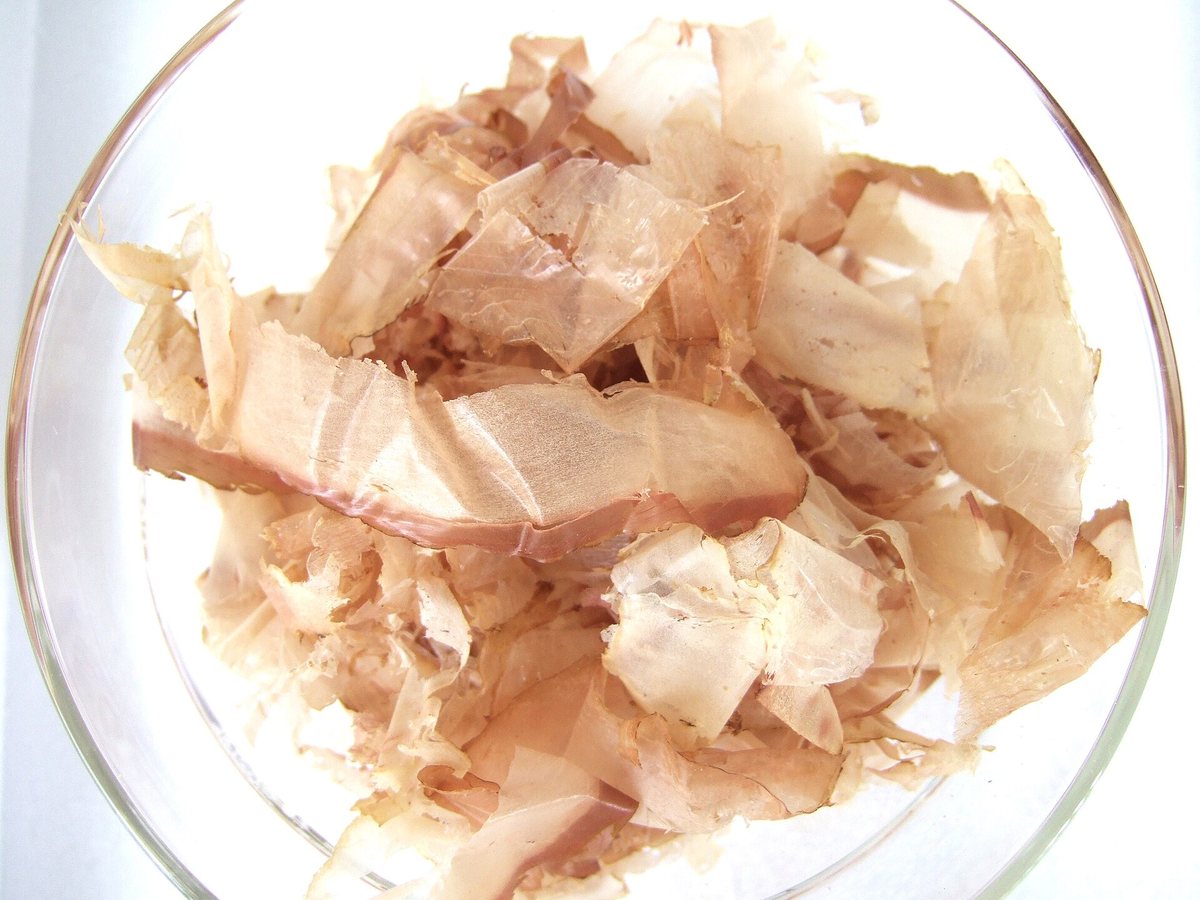
The dancers are thin flakes
The bonito flakes (katsuobushi) sprinkled on food are thin shavings cut from a block of dried bonito fish. Under the Japanese Agricultural Standards (JAS), flakes shaved to 0.2 mm thick or less are called thin shavings, and thicker ones are called thick shavings. When placed on hot rice or other hot food, thin flakes wriggle and twist.
Not just hot air
People often explain that the flakes "move because hot air blows on them." In 2024, a research team in China tested this. They cut a bonito flake and a small piece of plastic with about the same weight, thickness, and stiffness, both to 1 cm × 3 cm, and stood them over the spout of a steaming kettle. The bonito flake kept swaying from side to side, but the plastic piece did not move.

Heat and moisture together make it bend
What is more, the flake did not change shape when heat alone was applied by placing it on a hot plate, or when moisture alone was applied with a spray bottle. Since it did bend when placed on the palm of a hand, it is thought to be a material that bends from steam, where heat and moisture work together. Bonito flakes have lines like wood grain, and they bend along those lines.
Repeated bending becomes a dance
When the side hit by steam swells, the flake bends. Once it bends, the steam hits it differently, and it bends the other way. This repeats, creating a dancing motion. Flakes placed over steam swayed gently at 40℃ and kept flipping over at 50℃. However, it is said that there is still room to study the finer details of how this works.
Want to know more?
- Under JAS, the moisture in bonito flakes must be 9–17%. For flakes sealed in an airtight container filled with an inert gas, it is 21% or less.
- For flakes stood over 50℃ steam, the swaying got faster and bigger as the steam got hotter, up to 60℃. Above 60℃, only the speed increased.
- The research team compared the flakes, which keep moving in steam, to tiny soft robots (robots that move using soft materials).

Quick quiz: test yourself
Why do bonito flakes dance on hot food?
Show the answer
- Hot air blows them around
- Steam makes them swell and bend
- Static electricity moves them
Steam makes them swell and bend The side hit by the steam's heat and moisture swells and bends. Then the steam hits it differently, so it bends the other way, over and over.
The side hit by the steam's heat and moisture swells and bends. Then the steam hits it differently, so it bends the other way, over and over.
Next quiz ›Sources
- 木鱼花舞动的力学原理(The mechanical principle of bonito flakes dancing), 力学与实践 46(6), 2024中国力学学会『力学与实践』(安徽建筑大学ほか) (in Chinese)
- 日本農林規格 削りぶし JAS 1122:2024農林水産省 (in Japanese)
This article was written after checking the sources above as of 2026-10-03. Explanations may change as research progresses. Photo credits are shown below each photo.