Why does milk look white?

 The answer lies in a little trick of light. Let me explain in 30 seconds.
Milk is white not because something white is dissolved in it, but because of the way light scatters. Milk has lots of tiny particles floating in it: clusters of a protein called casein, and tiny droplets of fat. Light that hits these particles scatters in all directions and cannot pass straight through, so milk looks cloudy white.
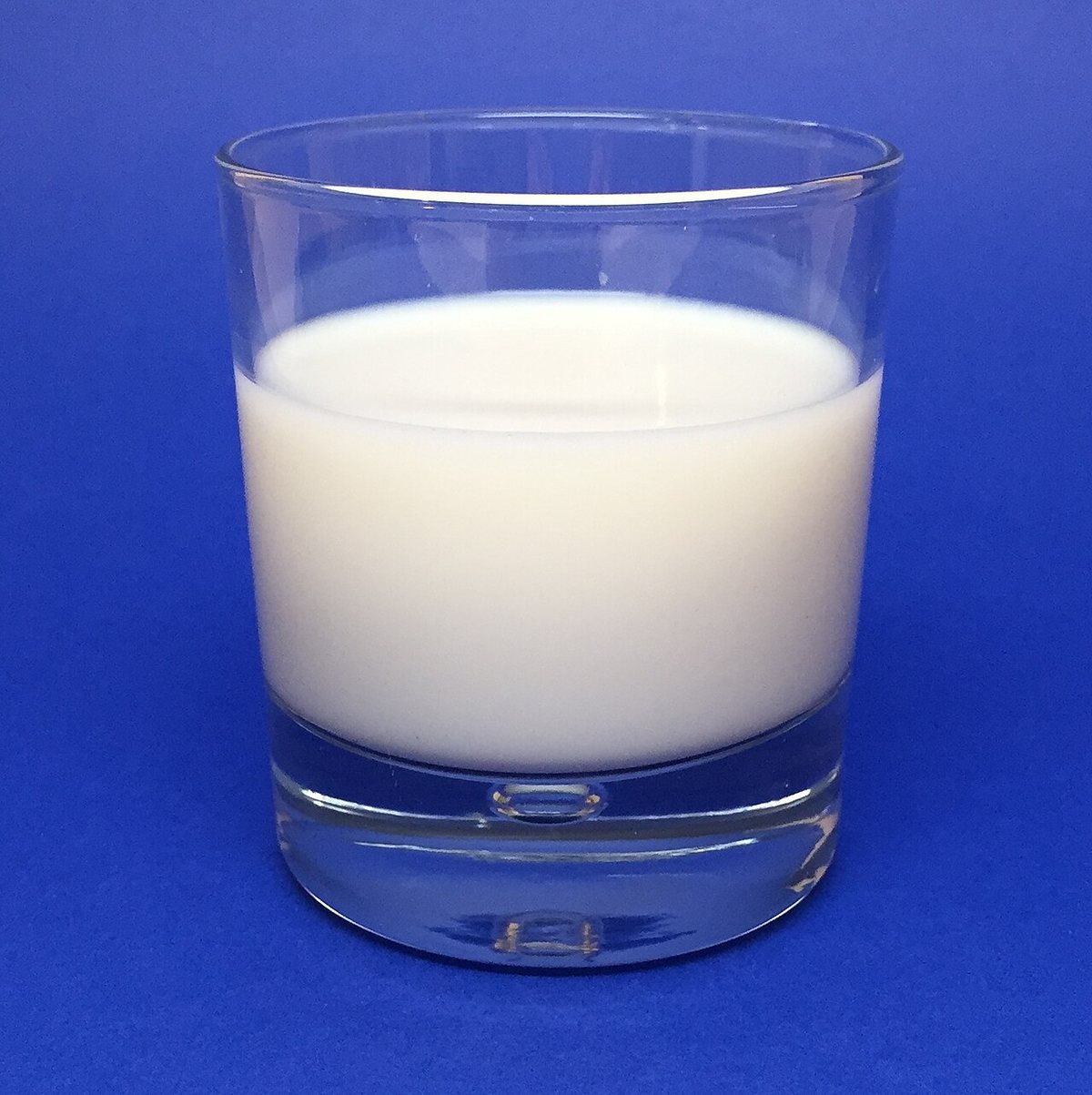
Two kinds of particles floating in milk
If you take the particles out of milk, the liquid left over (whey) is fairly clear. Floating in it are countless "casein micelles," particles made of clusters of the protein casein, and "fat globules," tiny balls of fat. According to material from Japan's High Energy Accelerator Research Organization, casein micelles are about 100 nanometers across (one ten-thousandth of a millimeter).
Scattered light looks white
When light hits fairly large particles that bend light differently from the water around them, it changes direction and scatters. Milk has a great many of these particles, so the light bumps into one particle after another, changing direction again and again. This light, scattered every which way, reaches our eyes, so milk looks white and you cannot see through it.

Big fat globules add to the white
Fat globules are larger than casein micelles. According to a research paper, the fat globules in milk straight from the cow are 0.8–12 micrometers, and in milk processed to break the fat into smaller droplets (homogenized), they are smaller than 1 micrometer. Milk's whiteness comes from both the casein micelles and the fat globules scattering light.
Why milk can look bluish or yellowish
The shade of milk changes a little depending on the kind of particles. Skim milk, with the fat removed, looks slightly bluish because the casein micelles left in it are small and scatter more blue light than red light. On the other hand, cream, which is rich in fat, looks yellowish because of a pigment called carotene in the fat globules.
Want to know more?
- The small proteins dissolved in whey are thought to play almost no part in milk's whiteness, because they are too small.
- If you mix skim milk little by little into a tank of water and shine a light from the side, the light's path looks bluish, while the light reaching the other side looks reddish. It is a long-standing classroom experiment that explains why the sky is blue and sunsets are red.
- Whey contains riboflavin, a kind of vitamin, which gives it a yellowish-green color.

Quick quiz: test yourself
Why does milk look white?
Show the answer
- Something white is dissolved in it
- Tiny particles scatter light
- Its calcium is white
Tiny particles scatter light Light hitting the tiny particles of casein protein and fat scatters in all directions and cannot pass straight through, so milk looks white.
Light hitting the tiny particles of casein protein and fat scatters in all directions and cannot pass straight through, so milk looks white.
Next quiz ›Sources
- 牛乳のナノサイエンス ~牛乳のミクロ構造が温度に対して敏感に変化することを発見~(プレスリリース)高エネルギー加速器研究機構(KEK) (in Japanese)
- Milk Composition - Colorful Milk(ANSC 438 講義資料、Internet Archive 保存版)University of Illinois, Department of Animal Sciences
- Observation of a temperature dependent anomaly in the UV translucency of milk useful for UV-C preservation techniquesScientific Reports(PubMed Central 掲載)
- Quantifying the "milky sky" experimentApplied Optics(Optical Society of America、グラナダ大学の掲載版)
This article was written after checking the sources above as of 2026-10-03. Explanations may change as research progresses. Photo credits are shown below each photo.