Why do rivers wind and bend as they flow?

 First, let me give you the answer in 30 seconds.
At a river bend, water on the outside flows fast and wears away the bank, while sand piles up on the inside, where the flow is gentle. Because the river keeps wearing away the outside and piling sand on the inside, the bend slowly grows bigger. However, depending on the soil of the banks or on construction work by people, some rivers do not wind.
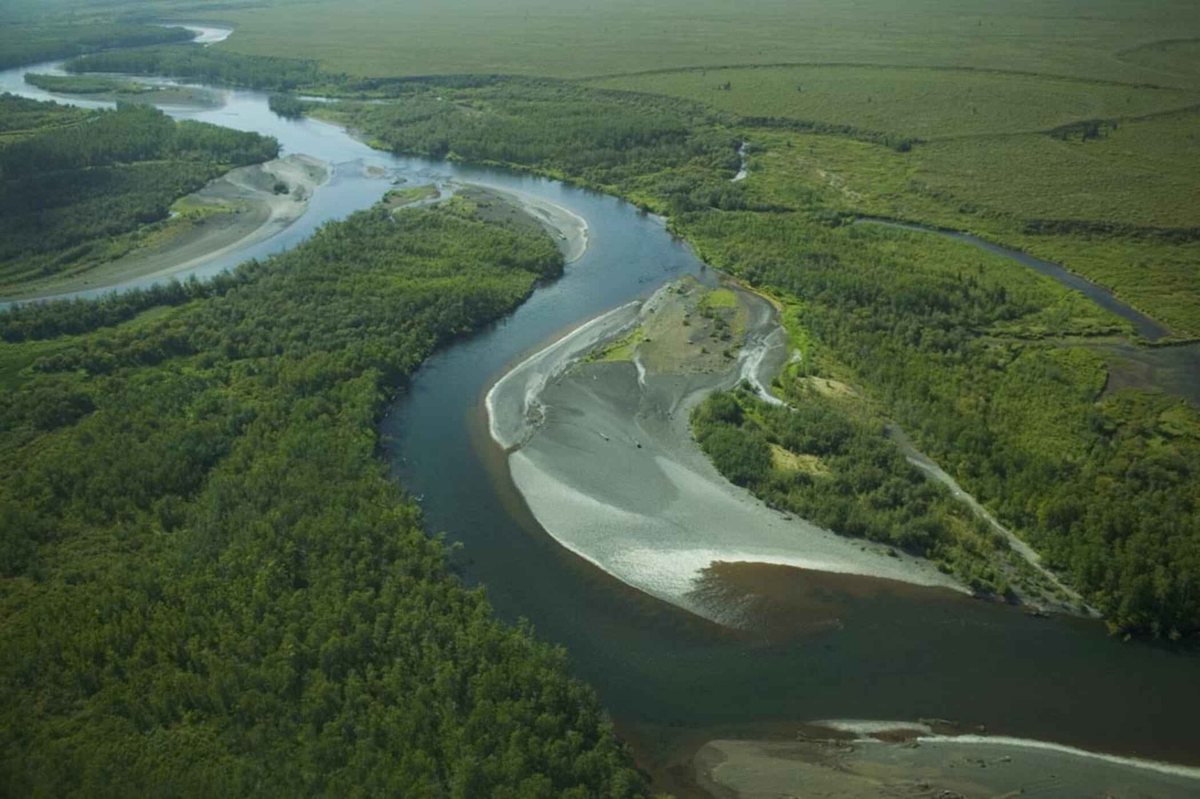
The outside wears away, the inside gathers sand
Where a river bends, the water on the outside of the curve flows faster than the water on the inside. The fast flow wears away the outer bank and makes a steep bank. Meanwhile, on the inside, where the flow is gentle, sand carried by the river piles up and forms a gently sloping sandy area. This sandy area is sometimes called a point bar.

A spiral flow inside the bend
Inside a bend, the water flows while turning in a spiral. Near the surface, water moves toward the outer bank, and near the riverbed, it moves toward the inner sandy area, carrying sand to the inside and leaving it there. This is explained as happening because the fast-moving water near the top and the slow-moving water near the bottom are pushed outward with different strength.
Bends slowly grow bigger
By wearing away the outside and piling sand on the inside, the river moves sideways while keeping almost the same width. In this way, the bend slowly grows bigger and also shifts downstream. When the neck of a bend becomes narrow, the river may take a shortcut through it during a flood, and the old part of the river left behind becomes an oxbow lake.
Some rivers don't wind
However, not every river winds. In experiments, when the banks were made only of sand and gravel that crumble easily, the river split into many channels. People also sometimes straighten rivers. On the Ishikari River in Hokkaido, channels were dug to cut across the bends and prevent floods, and over 52 years the river became about 58.1 km shorter.
Want to know more?
- In a winding river, the length measured along the flow is longer than the straight-line distance.
- The sandy area on the inside builds up mostly during floods, and its old positions can remain as low, bow-shaped ridges.
- The old parts of the Ishikari River (oxbow lakes) left behind by the shortcut channels are now used as parks and other places where local people relax.

Quick quiz: test yourself
Why do river bends slowly grow bigger?
Show the answer
- The inner bank wears away
- The river keeps getting more water
- Outside wears away; sand builds inside
Outside wears away; sand builds inside On the outside of a bend, fast water wears away the bank, and on the inside, where the flow is gentle, sand piles up. Repeating this makes the bend grow.
On the outside of a bend, fast water wears away the bank, and on the inside, where the flow is gentle, sand piles up. Repeating this makes the bend grow.
Next quiz ›Sources
- Fluvial Features—Meandering StreamU.S. National Park Service
- 5.9: Morphology and Dynamics of Meandering Streams (The Environment of the Earth's Surface)John Southard, MIT OpenCourseWare(LibreTexts掲載)
- 河川伝統技術データベース一覧(石狩川 捷水路)国土交通省 (in Japanese)
- 日本の川 - 北海道 - 石狩川国土交通省 水管理・国土保全局 (in Japanese)
This article was written after checking the sources above as of 2026-10-03. Explanations may change as research progresses. Photo credits are shown below each photo.